
If your air conditioner is running but the air coming out isn’t cold, you’re dealing with one of the more frustrating problems a homeowner can face in the heat of summer. The system sounds like it’s working, and the thermostat is set correctly. But, the house just won’t cool down.
Figuring out what’s causing the system not to cool comes down to checking the five top reasons a system stops cooling. A few of them, you can check yourself before calling anyone. Others need a technician.
Here’s what we look for when a customer calls us for a system that won’t cool (which, in the heat of summer, is considered an emergency).
1. The air filter is clogged
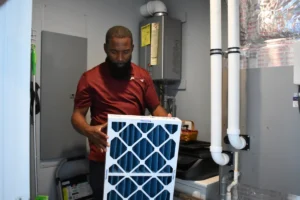 This is the first thing to check, and it causes the problem more often than people expect.
When the air filter is heavily clogged, airflow across the evaporator coil drops. The coil gets too cold, moisture freezes on it, and eventually you have a block of ice sitting inside your air handler. At that point, even though the compressor is running, almost no air is moving through the system.
What to do: Turn the system fully off at the thermostat. Let the coil thaw for a few hours (running the fan only can speed this up). Replace the filter. Turn the system back on and see if cold air returns.
If it does, you caught it early. If ice builds back up quickly, the coil may have another issue; low refrigerant is the usual culprit at that point, so if you call for service, be sure to let us know what you’ve already tried.
“If you notice your AC isn’t cooling, the best thing you can do is call a professional, turn the AC off, and set the fan to on. That way, in case of a frozen coil, it can be thawed out before we get there, and you’ll put less of a strain on the system.
When there’s a frozen coil, it’s very difficult to know if the problem is a mechanical, refrigerant, or airflow problem. When you can make our jobs easier and save time, it benefits everyone involved.”
– Jeff Beall, NATE-Certified HVAC Technician, Comfort Plus Services
2. The refrigerant is low
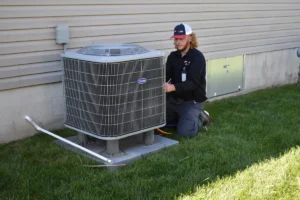 Refrigerant is what actually moves heat out of your home. When it’s low, usually due to a slow leak somewhere in the system, the AC loses its ability to absorb heat from the air inside. The system runs and the fan blows, but the air isn’t getting cooled.
Signs refrigerant is low:
- Air from the vents feels slightly cool but not cold
- The system runs almost constantly without reaching the set temperature
- Ice forming on the refrigerant line near the outdoor unit
- A hissing or bubbling sound near the unit (less common, but possible)
Refrigerant isn’t something that runs out on its own under normal circumstances. If it’s low, there’s a leak. Adding refrigerant without finding and fixing the leak is a temporary fix that usually lasts one season at best.
What to do: Call for a diagnostic. A technician will check system pressures, identify where the leak is, and give you options for repair based on system age, cost of the repair, and what’s the most cost-efficient answer. We cover this at every HVAC repair call.
3. The outdoor condenser unit is dirty or blocked
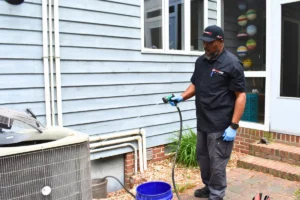 The outdoor unit (the condenser) is where your AC dumps the heat it pulled from inside your home. If the coil fins are coated in dirt, cottonwood, or grass clippings, or if shrubs have grown in or around the unit, it can’t release heat efficiently. The system strains, efficiency drops, and on a hot day it may not be able to keep up at all.
This is especially common on Delmarva in late spring and early summer, when cottonwood and pollen coat everything outdoors.
What to do: Turn the system off. Gently rinse the condenser fins from the inside out with a garden hose (not a pressure washer, which can bend the fins). Clear any vegetation within two feet of the unit on all sides. Let it dry and turn the system back on.
If the fins are heavily damaged or bent, a technician can straighten them with a fin comb and assess whether deeper cleaning is needed.
4. The evaporator coil is dirty
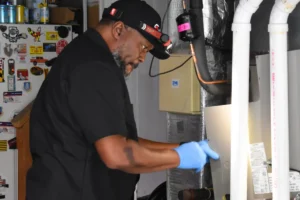 Even with a clean filter, the evaporator coil inside your air handler accumulates a thin layer of dust and debris over time. A dirty coil insulates itself from the air passing over it, which reduces its ability to absorb heat. This is the same heat exchange problem as low refrigerant, just due to a different reason.
This tends to show up gradually. The system slowly becomes less efficient over one or two seasons until a hot day exposes how much the unit’s cooling capacity has declined.
What to do: This one requires a technician. Cleaning an evaporator coil involves accessing the air handler, applying coil cleaner, and in some cases removing the coil entirely if buildup is heavy. It’s part of a standard HVAC maintenance visit and one of the reasons annual tune-ups matter. Catching a dirty coil before summer starts is far easier than dealing with it during a heat wave.
5. The system is undersized for the conditions
 Sometimes the AC is working exactly as designed, but it wasn’t designed for what it’s being asked to do.
If you’ve added square footage to your home, converted an attic or garage, lost significant insulation, or if you’re dealing with extreme heat combined with high coastal humidity, your existing system may simply not have the capacity to keep up. Heat and humidity together are a genuine load on an AC system, and Delmarva summers regularly push both.
An undersized system will run continuously, never quite reach the thermostat setpoint, and wear out components faster than a properly sized system would.
What to do: If you’ve ruled out the other four causes and the system is relatively new and well-maintained, ask us to set up a service call and do a load calculation. We can determine whether the system is correctly sized for your home’s current conditions and, if not, walk you through replacement options. Those could include high-efficiency systems and ductless setups that handle humid coastal air well. Learn more about HVAC installation.
When to call immediately
Some of the causes above are safe to investigate yourself. Others need professional attention quickly to avoid more damage to the unit, or health risks from prolonged heat exposure. Call us at 866-950-2653 if:
- The system has been running for hours with no cooling at all
- You see ice on the refrigerant lines or the air handler
- You hear unusual sounds like grinding, hissing, or banging
- The outdoor unit isn’t running at all while the air handler is on
- The circuit breaker for the AC has tripped
We offer 24/7 emergency HVAC service across the Eastern Shore and Delaware. If it’s the middle of a heat wave and the house isn’t cooling, don’t wait.
Get it diagnosed right the first time
Most of the issues above take an experienced technician less than an hour to diagnose correctly. Our NATE-certified technicians carry the tools and parts for the most common repairs and major manufacturers, and we’ll talk with you honestly about replacement when it makes sense, and not before.
Schedule HVAC Repair or call 866-950-2653.
We serve homeowners and businesses across the Maryland Eastern Shore and Delaware, including Sussex County.


